Author
Sidecar Engineering
Published
In freight, who owns a customer is a matter of relationships, and relationships move. People leave, accounts change hands, a customer one office grew for years starts routing through another branch. Enterprise Ambient Calibration is the part of Sidecar that keeps up with those shifts on its own, reading them from how your team actually works instead of waiting for someone to update a record.
The record goes stale the day after you write it
Ask a freight forwarder who handles a given customer, and the honest answer is a relationship, not a row in a table. A salesperson built that account over years of calls and the occasional weekend favor. When an RFQ comes in it reaches them, and they bring in the pricing person they trust on that lane. None of it is arbitrary. It is the working knowledge of people who know each other and know the business. Most companies write part of it down, in a spreadsheet or an ERP field, and leave the rest in the heads of the people who have been there longest.
That arrangement is right up until it changes, which it always does. A senior salesperson leaves, and the accounts they carried get split among the people they trusted. A customer the Chicago office grew starts routing through the West Coast branch after a reorg. A pricing person picks up a lane while a colleague is out, and the work never moves back. None of this gets announced. It happens in the work itself, and whatever record the company keeps drifts away from how the desk actually runs.
For most AI systems, that gap is where things break. The system keeps routing a customer's rate requests to the person who left, because nobody told it otherwise. The drafts go to the wrong desk. The escalations land with someone who stopped owning the account in March. Either a human notices and edits the record by hand, or the system keeps making the same wrong call, confidently, every time the customer writes in. The reason is always the same. It never captured the change.
What the Enterprise Ambient Calibration does
The Enterprise Ambient Calibration (the Calibration, for short) keeps the system's picture of your business current by watching how the business actually runs. It sees the real shape of the operation as it happens, including who picks up which customer, who prices which lane, and who gets pulled in when something is off. That picture is more honest than any directory kept by hand, because it comes from the work itself and not from a description of the work written down once and left to age.
Who-handles-what is the clearest place to start, because it is easy to see when it breaks and easy to trust when it holds. When a customer quietly moves from one handler to another, the Calibration reads the new pattern across recent threads, works out that the account has changed hands, and corrects the routing so the next RFQ lands in the right place. Nobody had to catch the change or remember to file it.
That same calibration reaches well past routing. Almost anything the system needs to know about how you operate can drift the way a handler assignment does, like which carriers a customer wants quoted, how a particular lane gets priced, or when a shipment needs a second set of eyes before it leaves. Each of those lives in how your team works long before it becomes a written rule, and each goes stale the same quiet way. The Calibration reads those patterns as they form and keeps the system lined up with them, so the platform keeps acting like it knows your company even as your company changes.
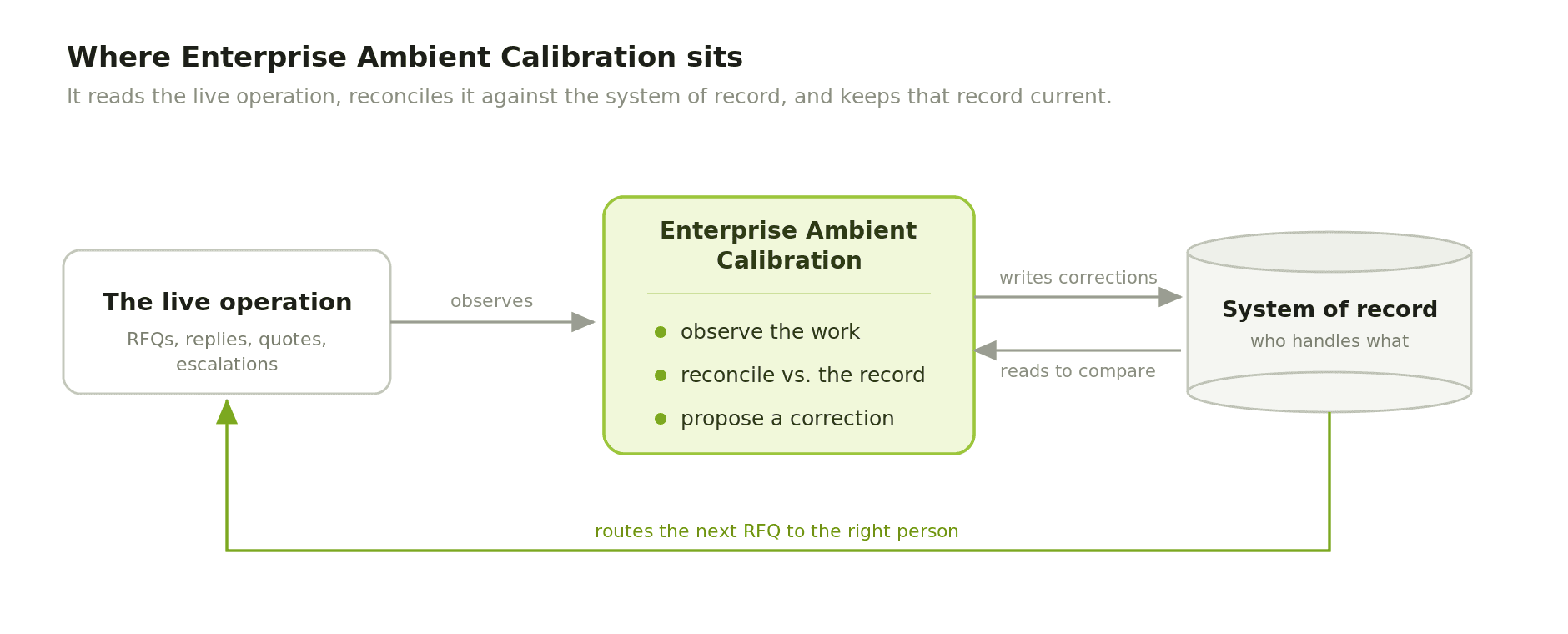
Figure 1. Where the Calibration sits. It observes the live operation, reconciles what it sees against the system of record, and proposes corrections back to it. The corrected record is what routes the next RFQ, so the picture stays current without anyone maintaining it.
It helps to name what is happening here. Enterprise AI runs on two systems. A system of record holds what the company knows, the directory, the customers, the rules. A system of action does the work on top of it, reading a request, routing it, drafting the reply. For a long time the arrow only ran one way, from record to action, and the record stayed current only if a person kept it that way. The Calibration runs the arrow backward. The system of action, the work as it actually happens, corrects the system of record, and a truer record makes the next action sharper. That is the loop, and every pass through it tightens both halves.
How it works
The Calibration runs continuously in the background, and it never asks your team to log a change or tag a handoff. When it finds something that no longer matches what the system has on record, it writes up a proposed change and attaches the threads it reasoned from. Your team sees those proposals in one place, sorted into new entries, updates, and conflicts, each carrying its own evidence, so a person can check the reasoning in seconds instead of reconstructing it. The confidence score on each proposal is what makes this safe to run on its own. A change resting on a single thread is held back for review. A handler who has clearly taken over an account across dozens of recent shipments is a surer thing, and the Calibration can apply it without waiting. Your team decides where that line sits, and the moment a change goes in, the next RFQ for that customer routes the new way.
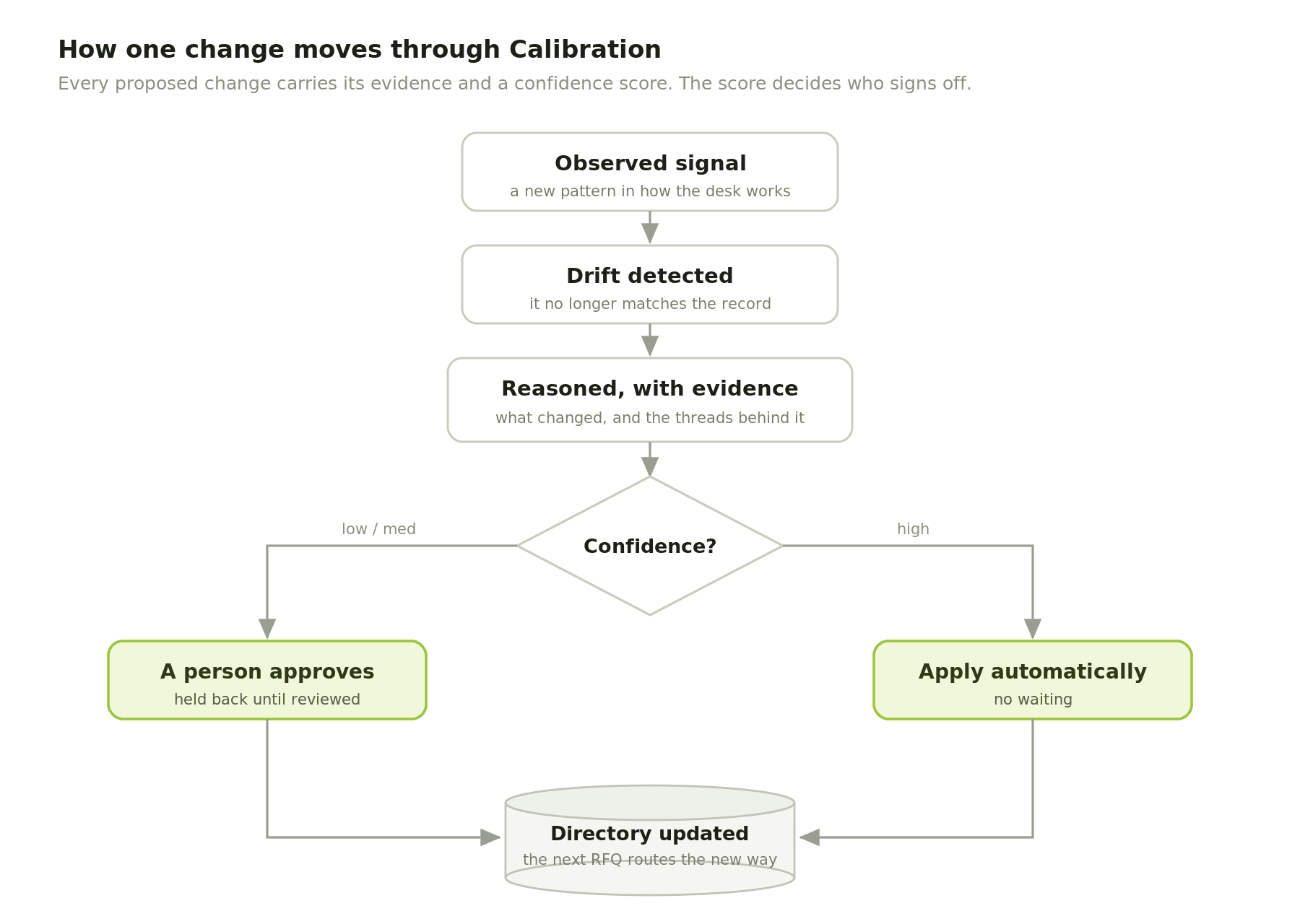
Figure 2. The life of a single change. A drift the Calibration detects becomes a reasoned proposal carrying its evidence and a confidence score. High-confidence changes apply on their own, the rest wait for a person, and either way the directory and the next routing decision move together.
What changes for your team
The work of keeping the system current stops being anyone's job. Today, on most platforms, someone has to remember that a customer changed hands and go edit the record, usually after the system has already misrouted a few times and somebody complained. With the Calibration running, the correction tends to arrive before the complaint does. An account that got handed over on Tuesday shows up as a proposed change that week, with the threads that prove it, ready to approve.
It also changes what onboarding means. A customer's directory does not have to be complete and perfect on day one, because it fills itself in as the work flows through. That record is no longer something your team has to keep up by hand. The Calibration keeps it true as the desk moves.
Intelligence was never the bottleneck
Every serious AI system for freight is smart enough. The model can read an RFQ, weigh the options, and draft a quote about as well as a capable operator. What decides whether it is actually reliable is something quieter, whether it knows how your company works and stays right about it as your company changes. A system that is brilliant on day one and wrong by the third month does not fail loudly. It fails one reasonable-looking decision at a time, and those are the hardest errors to catch.
This is the part of the problem the industry keeps underestimating. The knowledge that makes a forwarder good lives in how its people actually operate, and most of it never makes it into a document. It moves when people move. The Enterprise Ambient Calibration is how that knowledge stays in the system instead of leaving with them, drawn from the work as it happens and kept current as the operation shifts underneath it.
The best freight companies of the next decade will be small teams moving the volume that used to need a floor of people. That only holds together if the system underneath them keeps pace with the business as it actually is, not as it looked on the day they signed up. Every correction the Calibration makes is a small act of staying current. Enough of them, and the software stops being a snapshot of your company and becomes a living picture of it, sharper every week, with nobody assigned to keep it that way.